Showing posts with label Tutorials. Show all posts

Wednesday, November 19, 2008

Best Shuffle Tutorial Ever !

Our good friend Len Hall from
We Dance Hard has just released what MSO considers to be the best Melbourne Shuffle tutorial ever. - and yes you may quote us ;)

Great job Len. This DVD is a fully comprehensive guide to shuffling. With fantastic clear footwork for all the common shuffle moves spins etc. And there's enough time in each example to actually practice along with it. A great way to learn and practice at the same time.

Beginners...I defy you to get lost with this dvd ;) No excuses, it's everything you need to learn, practice and at the end shuffle along to with a great music video section with live shuffle party footage, vid mixes and stomping soundtrack.

This is where to get it  >>>

http://www.wedancehard.com/dvd/

Sunday, November 2, 2008

Advanced Shuffle Footwork - Exercises #1

We've had a great response from our Advanced Shuffle Footwork post, and lots of questions on HOW YOU DO IT ! :)

  • If you're new to the Shuffle, start here, on the MSO forum for lots of information on moves, styles, what shoes, how to use baby talcum powder on the floor, stretching exercises, balance exercises, why did we do the Shuffle in the first place, who started it etc.

    You can ask questions and get answers as well, it's beginners friendly (no flaming or dribbling) and designed to encourage you to Shuffle and help you improve.

    http://mso1.cultureforum.net/tutorials-f1/where-do-i-start-t54.htm 

As we've mentioned, shuffle footwork is based on Celtic Dance and the vids posted below will give you enough information to keep you busy for 6 months.

Turns, spins, jumps, hops, sideways steps, kicks, all these basic movements are used in shuffling and this is where they came from, Celtic Dance.

You don't need to do them exactly like the vids unless you want to learn strict Irish Dance. But the exercises are great for getting your similar shuffle moves working properly. They'll also give you a breakdown of the steps from different angles with English language commentary.

The moves and steps are for both male and female.

Irish Dance Movements

beginner slip jig

men's reel

steps broken down


Here's some great instructions from Learn To Dance http://www.learntodance.com/

The first thing to remember is that at all times during the dance your arms must be straight and held down by your sides (Like a soldier at Attention)

Basic Position  (This position is usually called the 'T" in shuffling)

Start with your feet together with the heel of your right foot by the toes of your left foot. Feet at 90° to each other. This will mean your right knee has the left tucked behind. This position is the normal position after each step, changing to ending with the left foot in front instead, and vice versa.

The Basic Steps
There are three basic steps to Light shoe dances, around which all dancers are built.

Teachers weave these into their choreography in different ways and vary them slightly, but if you can't master them in their basic form you will never really make the grade as a step dancer.

The basic steps are the Jump Threes, the Hop Threes and the Sevens or Side Step.

Jump Threes (basic step)
Start in Basic Position

1) Now lift the front leg (in this case the right) keeping it dead straight with the toes curled forwards, so don't try to lift too high. (The worst thing you can do is point your toes up so that people see the soles of your shoes)

Jump off the foot still on the floor onto the raised foot, landing just in front of where it started.

As you jump bring the back foot up to kick your behind.
This is all done at the same time so takes practice!

2) As you land, step forward onto the original back foot, placing it just in front of the other foot.

3) Tuck the original front foot "behind" to end up in "basic position" but with the other foot now in front

Jump threes are always started from whichever foot is in front.

Do threes very slowly to start with and build up speed. One Three per bar of music. Once you have the hang of them try the lead round

Hops threes (basic step)
Start in Basic Position

1) Hop on the back foot as high as possible, landing back on the same foot.

At the same time the front foot is brought up across the knee of the other leg, as high as possible (try to  touch your hip with your toes)

2) step very slightly forward on front foot

3) tuck back foot behind

Hop threes are always started by hopping off whichever foot is behind. One three per bar of music.

Sevens or side step (basic step)

1) is a hop or jump
2) The leading foot is moved to the side
(for example, the leading foot is the right one so move right, left foot move left)
3) back foot moves the same direction but crosses behind
4) front foot again
5) back foot behind again
6) front foot again
7) back foot behind again

All Irish Step dances follow the same basic pattern.
There are usually several components :

The Lead Round
The First Step

The Second Step (or Lead Back)

As the dances become more advanced these become a little harder to distinguish. However in the early stages they are very easily defined. Below is a basic beginners reel.

A Beginners Reel
this is a Beginners Reel, so choose Reel music. Try not to make it too fast, as this is hard work!

A Reel is a soft shoe dance so either get some proper Irish shoes, or use ballet shoes or the like (preferably black)

For a costume you need something with a shorter skirt (above the knee) with plenty of material so that you can lift your legs freely. A Sports skirt would be fine, although something a little more colourful would be better.

A simple white blouse with loose sleeves would also suffice. If you really want to look traditional then take a simple scarf and pin it onto the left shoulder. Then drape it across the back and pin it at the waist on the right side.

Count the bars in your mind, stood in basic position.(the bars are usually easy to count in Irish music)

At the first note of the sixth bar point your front foot and toes forward moving the leg ahead of the back foot so that only the toes touch the ground.

Keep your feet in the same turned out position as in basic position.

You do not start dancing until the first note of the ninth bar

LEAD ROUND
The lead round is simply Eight continuous Jump threes in a circle, alternating leading legs.

You must end up back where you started, facing the front again.

As each persons jumps are different don't try to follow someone elses circle.

FIRST STEP

A
Hop three twice
Hop Seven side step to right
Jump three twice
Jump seven side step back to left

B
repeat A but to opposite side

C
Repeat A again but this time move forward more with each hop three (on step 2 of the three)

D
repeat C but opposite (your sevens should be along the very front of the stage)


LEAD BACK

Repeat Lead round (eight jump threes), but instead of creating a circle just curve back to end your last three facing the front again in your original starting place in basic position


FINISH

To finish any Irish Step dance do the following :
Point your front foot as if starting, and bow from the waist, head and face up, arms still by your side.

Then turn towards the musician (or person running the music machine) and bow in the same way to them.

This is a recognised show of respect that all Irish dancers uphold, and it looks very smart.

Stand up straight, turn left and walk off stage with arms still by sides, and still straight legs and pointed toes.

Tuesday, September 23, 2008

How To Make A Shuffle Crew


Any shuffler will tell you, the only thing better than shuffling, is shuffling with friends.

The Shuffle is a social dance, that's how it began. A bunch of friends getting together and doing what they love, Shuffling. Simple as that.

Whether it's 2-3 friends hanging out at home or hundreds at a Shuffle event, being with others who have the same passion for Shuffling is a buzz like no other.

There can be dozens of different types of crews, and not all crew members need to be pro shufflers. Some members may not be able to shuffle at all, yet they can be just as valuable a member as the crew stars who win competitions.

Lets have a look at some of the different types of crew members.

A crew can have any or all of these types of members, and one member can do more than one role.

> PERFORMERS

These are the most visible crew members. They'll be the ones who are in the crews shuffle vids and enter competitions.

Often the competition crew members form teams. Shifter Hardstyle Prodigy for example have 50 members and a number of teams, from the most experienced older ones, to starter teams for the younger ones who are in training.

Having different teams in your crew gives everybody a chance to perform at their skill and age level.

Generally new crews will just have one team who are all at the same age/skill level to start with.

> FILM CREW

These are the people who video and edit the performers. They don't need to be able to shuffle, but they do need to have a passion for shuffling and understand Shuffle culture.

The film crew provide valuable feedback to the performers. Together they can view the shuffling and discuss how to make it look better, or have a greater impact.

The end product, usually a youtube vid, is how the world sees the crew, so it is a very important role. Film crews need to keep up with the latest editing styles, software and cam techniques, just as the performers need to keep developing their moves.

> WEB

All crews need some sort of web presence, a myspace, friendster, orkut page etc, and often a forum, for updates meet ups, comps. Even for posting vids online.

So crews need a good web tech who loves this stuff, and knows how to manage all the online activity.

Online time moves FAST it's a fulltime job just keeping up. So this is often a great opportunity for someone who's not a great shuffler, but is a great tech and can spend a lot of time keeping up with online developments and work with the rest of the crew to make online content work for the crew.

> ARTISTS

Well of course if you're gonna have a crew, you need some crew artwork. That's where the visual artists come in. They will discuss with the crew all sorts of ideas for that big crew logo you want on the back of your hoodies, to the header on your crew page.

Artists understand shuffling really well, as most of the oldskool shufflers were artists to start with. So the crew artist/s will express in a graphic form what your crew is about.

logo's need to work on all sorts of levels, from hoodies, to grungy youtube resolution, it's a fine art (pardon the pun) getting the balance right, and artists need to keep up with changes in styles just as much as the performers do.

> DESIGNERS

Your crew will probably want it's own phats, competition costumes and will want to sell it's own merchandise at some stage. That's where designers come in.

It's a fashion area, so you need someone with fashion design knowledge, an understanding of fabrics, and clothing manufacturing techniques.

Cript Ballas for instance have their own tailor who makes the crews phats. That's a great idea, and the crew designer is the one who understands the demands of wear and tear on clothing, especially clothing that has to perform hard in shuffling and not fall apart in the middle of a comp. Not a good look to have a bit of reflective fabric come off in the middle of the comp finals and trip everybody over on stage ;)

> MUSIC

Most crew members will have their favourite tracks to shuffle to. Keeping up with latest tracks and changes in styles is a busy job.

Some crews are now considering working with musicians and composers to write tracks specifically for their crew. As a musician and composer myself, I think that's a great idea. I've spent most of my life writing music for dance crews and dance productions, I love it. It gives the crew a real edge to tailor make the music they shuffle to, and helps them stand out from the crowd with a truly unique combination of music and dance.

The difference between a musician and composer is, a composer writes the music, a musician plays it (like a guitar or keyboard). They can be the same person. A composer is different to a 'producer', a producer generally does not create or write the music, they generally use pre recorded loops and samples and just rearrange them with a computer. The risk with loops is, you can sound just like everyone else. But that's ok when you're starting out.

> CHOREOGRAPHY

You may find someone in the crew is great at choreography, they can stand back and arrange the shuffle moves to make an impressive routine.

Often individual shufflers can come up with great ideas, but sometimes these can get lost in the rush, if you don't arrange them and pace them. For instance you'd do a 30 sec shuffle routine differently to a 5 min one. And it'd be different again if you are working with a team of 8 shufflers for a competition. That's where a choreographer comes in.

> ADMIN

Most crews will have someone who takes care of the administration stuff of the crew. Someone who is the contact for the crew to answer emails, phone calls etc.

This can become quite a lot of work when your crew gets to 30-50 people. Admin organise information so everyone knows when a practice is, or when you need to pay entry fees to a competition etc.

Admin can be a great job for someone who loves doing that sort of thing - most shufflers loathe it ;) but it needs to be done and done properly. For instance when I want to contact a crew, perhaps to offer them a contract to be on a shuffle dvd, I look for the person who does the admin. That way I'm pretty confident that my messages will be passed on to the relevant crew members, and my emails will be returned.

> SUPPORT CREW

When you have to get 30 members to a competition on time, you need a support crew. Firstly to make sure everyone has transport to get there and back, and also transport all your costumes etc. Perhaps even arrange for food if it's an all day competition event.

Often it's girlfriends/boyfriends with a car or helpful parents doing all the running around. It's a great way for them to not only 'feel' like part of the crew, but to actually do something practical, to free up other crew members minds to concentrate on the competitions etc.

> FANS

Fans are great, they'll support you at events, give you encouragement when you're down or missed out on a place in a comp, and will generally be a delight to have around.

Fans want their crews to succeed, in what ever the crews are doing. So make sure you let fans become part of your crew somehow, wearing your crew hoodies, talking about 'their' crew on forums and comments pages, and letting everyone at school know you exist.

There's nothing like turning up to a competition or a Shuffle event and seeing a crowd of friendly welcoming faces who are there to cheer for you, knowing that you're probably scared to death with nerves...

So make fans part of your crew, they're worth their weight in gold !

HAVE YOU GOT SOME QUESTIONS OR TIPS ABOUT CREWS ?

JOIN US ON THE MSO FORUM http://mso1.cultureforum.net/tutorials-f1/how-to-make-a-shuffle-crew-t119.htm

DO YOU HAVE A CREW ? TELL US ABOUT IT

http://mso1.cultureforum.net/teams-crews-f10/

ARE YOU LOOKING FOR NEW CREW MEMBERS ? POST A CALL FOR CREW MEMBERS HERE

http://mso1.cultureforum.net/teams-crews-f10/

Friday, September 12, 2008

Advanced Shuffle Footwork

Most Shufflers get bored with running man, and lets face it, a move you can learn in 5 minutes can get pretty dull after a few months.

The move popularised by one hit wonder McHammer (1990)was a common sight in aerobic gyms across the world for a decade by then. It's what people looked like on a gym tread mill. Running on the spot was also a warm up exercise for sportspeople across the world, as well as dancers.

McHammers running man was often derided as his failed attempt at Michael Jacksons Moonwalk. It was too hard for McHammer, so he did this gym exercise instead.

McHammer's only hit U can't touch this, is a classic 1980's gym workout music video, like former Melbourne girl Olivia Newton-John did in 1981 with (lets get) Physical and the frightening Jazzercise - Move your Boogie Body of 1982...oooh yes, it is as bad as it sounds, but the video tapes sold more than records.

So people like McHammer jumped on the gym bandwagon and did a McHammersize track, complete with cheesy lycra/spandex booty in your face. To give you something to look at while exercising in front of your TV.

  • McHammers - U Can't Touch This, is not all that original either, it's just a remix of Rick James 1981 hit Super Freak.
Rick James "Super Freak" 1982 [update: seems this particular vid has been taken down, but it's worth doing a search to check out the track.]


Jazzercise - Move your Boogie Body 1982


McHammersize. MC Hammer - U Can't Touch This (1990)


McHammer was probably the last of the genre, thank god ;) In 1990 Wall Street had just collapsed and triggered global recession and the Berlin Wall  had been torn down by ordinary people on both sides of it, just fed up with the whole superpower, superego trip Russia and America had been on for a lifetime.

It was a brave new world and we didn't want anything to do with the one we'd just torn down, we were sick of it. Like life was the running man, you run but you go nowhere.

Because of Melbourne's large and long established Celtic community ( mostly Irish, Scottish,Welsh ) Celtic dance was our first stop for inspiration when wanted the foundation to create a new dance for a new era.

The so called shuffle 'T Step'  is the classic Shuffle. It's a simplified version of Celtic Dance.

I'd recommend shufflers who are tired of Running Man to have a look at this stuff. Because that's what we did in the creation of the shuffle when we needed inspiration.

You will find enough steps in the first 60 seconds of the opening solo of 'Feet of flames' Warriors from Riverdance in the vid below, to keep you busy all year.

For all you crews looking for inspiration...

You will see synchronised choreography for 30 members so tight, you will weep with tears of joy. And in the vids are original Melbourne Shufflers, who auditioned in Melbourne and landed roles to tour the world with Riverdance in the mid 1990's. All done live on stage in front of picky audiences who love excellence in dance, just like shufflers today.

And the more you see it the more you see the brilliance of the artistry that has been cherished for centuries. Like fine interlaced Celtic artwork itself, whether on shields, swords and jewellery, or in sacred books and carved in stone. It still has a magic buzz like no other.

Dance in Celtic culture is seen as a sacred part of it's culture, often with magical powers. There are many tales of Celtic dance transporting you to the Celtic OtherWorld.


Shuffle footwork is based on Celtic dance, Welsh, Irish and Scottish Highland mostly. Most Europeans would spot the similarities in the dance styles in a seconds.

The earliest direct linage is Clogging

More than 800 years ago Welsh seamen danced on the wooden decks of their sailing ships in wooden clogs, and Clogging was born. Clog is from a Gaelic word (traditional Celtic language) meaning 'time'.
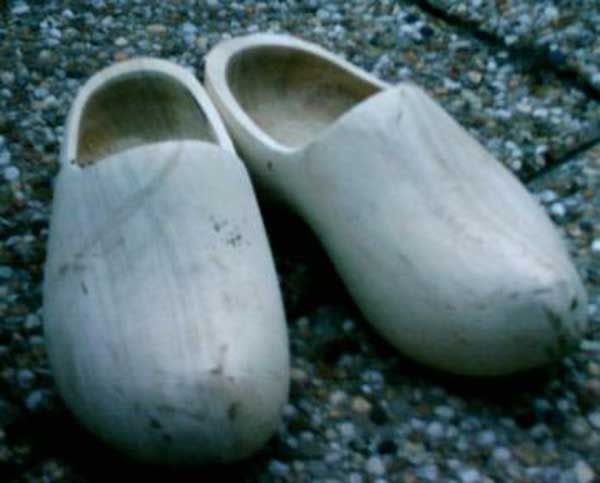
'Time' as in keeping time when dancing. The clogs were the percussion / drum section. The rest of the music usually provided by pipes, banjo's and later fiddles (violins). The dance quickly became a favourite and is still practiced centuries later, today.

Variations spread to different regions by the sailors when they were in port, often combining with local folk dance traditions to form Irish dance, Scottish Highland dance and Flamenco in Celtic Iberian/Spanish.  

Clogging went on to become the foundation for tap dancing, introduced to America first by Irish/Welsh sailors and later Celtic and European immigrants. Over the centuries regional variations emerged and local cultural dance was often included.
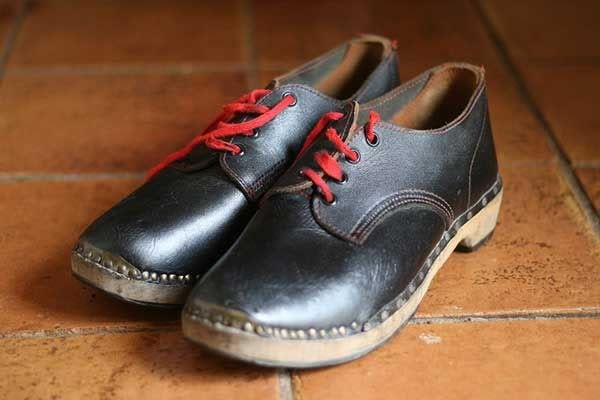
The full wooden clog made way for a leather top clog around the 1400's as the dance moved inland to wooden floored dance halls and ballrooms. Such as the traditional Lancashire wooden soled clog (pic above right)

Clog dancing is also known as Stomping, which is what the oldskool Melbourne Shufflers called themselves - Stompers.
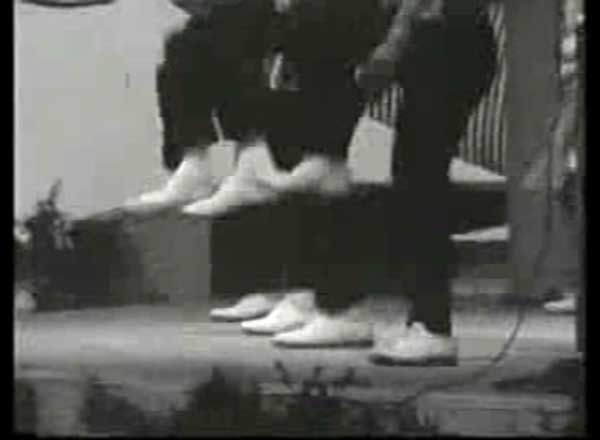
The single biggest difference between Shuffling and other street dances today, is that Shuffling is danced 'in time', ie strictly on the beat. Your stomping foot keeping time, exactly as it's been done for centuries in clogging.

Clogging, or Stomping as it was called locally, was the standard dance style in Melbourne for much of the 1960's to 1980's as traditional folk dance became popular in the folk revival years. Melbourne has a very large Celtic population. The steps fitted as easily with pub rock as they did with electronic dance or traditional Irish jigs.

It's from here the Melbourne Shuffle inherited it's core basic steps. All the instantly recognisable shuffle moves are in traditional clogging.

Hardstyle (Stomping), Shuffling (sideways movement by twisting heel/toe)  kicks, running man, glides.

The big hit Irish Dance stage show Riverdance hit the world stage mid 1990's just a few years after the Shuffle started, and really kicked interest in Shuffling over the moon.

Celtic dance has been around for many centuries, as well as the Celtic dance music styles, the jig (gigue) and reel.

These are basically melody loops. The musicians would play a 4, 8 or 16 bar melody then repeat it 4 times often getting a bit faster each time, then change tunes, They could go on for as long as people wanted to dance. Exactly like DJ mix today.

You could go on all night with fresh musician's 'sitting in' when the other musicians got tired. All without missing a beat.

This is a dance style that has lasted centuries and still has people in awe with the skill and pleasure this extraordinary dance brings.

In the 1700's it was actually outlawed by the English Monarchy along with playing Celtic pipes and wearing tartan. The penalty was death - yes seriously. The law lasted for 50 years.

So we figured something that had survived wars and death threats, was something that had soul and spirit and freedom, just like we felt at the end of the Cold War.

These 5 vids are taken from live Riverdance and feet Of Fire performances, no  trick photography, no quick editing to make it look faster, just well practiced dance.

This is the Irish styled celtic dance, the arms are generally kept firm at the sides, in Scottish celtic dancing the arms are used a lot more, such as in The Highland Fling and Sailors Hornpipe. This arms-at-the-side thing is a common sight today in Shuffling, with attention on the footwork.
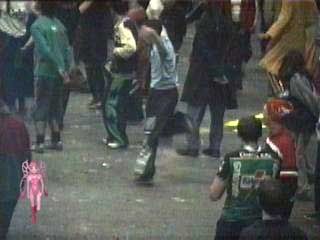
Scottish highland styled arm work (G.Shepherd 1994)

There were a number of very well known oldskool shufflers who did great intricate Irish styled footwork. I even have footage of a famous shuffler who did variations of jigs, sailors horn pipe etc, and The Goodies, Tim Brooke Taylor's 'I'm A Teapot' routine - excellent :)
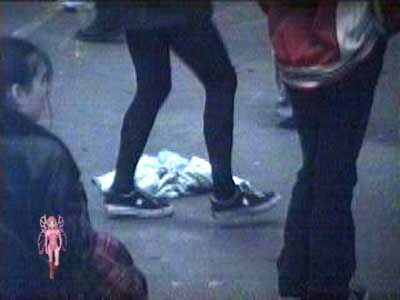
A common sight at oldskool parties, shuffle girls with traditional Irish Dance skirt and stockings. (G.Shepherd 1994)

You'll hear the traditional pipes, and all the footwork is strict Irish dance - the original tap dancing introduced to New York by Welsh and Irish Immigrants in the 1800's.

Remember the footwork is in strict time with the music, the tapping sound from the heel and toes are used as percussion instruments as well as feet. Originally the shoes were chunky wooden soled ankle boots, now they have small metal plates.

If you wanted a slight pause you would time your footwork to include a small leap where you could change feet and leg positions ready for the next sequence, landing precisely on the beat.

You will also see costumes with reflective lines and patches inspired by Melbourne's Phats.

Riverdance is based on stories from Celtic Mythology.

In Celtic Culture women and men are honoured as great warriors, heroes, champions and artists. There is never any question or suggestion that girls can't dance. Any oldskool celtic shuffle girl could dance a guy on the dancefloor into the ground, with ease... ;)

In Celtic tales a young male warrior would often have to fight a female champion to prove his worth. They could never beat her, they could only survive the test.

A shuffler will need 5 hard years of training to just do the steps of the synchronised routines, and 5 more years to make them brilliant.


SHUFFLE LANGUAGE

For shufflers wanting to increase their shuffle vocabulary ( 1 move = 1 'word'), here's a clear and brilliant example of how it is done.

Take note of the first vid in the series below. Watch the lead male character, the guy with the mask and Celtic X on his chest.

Feet Of Flames Warriors, is about the noble, but often nasty, celtic warrior class. To illustrate that, the choreography uses para-military uniforms that would immediately suggest an Army to a modern audience. Even including some marching routines if we didn't get it the first time.

To demonstrate the power and honour the warrior class has about itself, the choreography uses modern day body building poses as symbols of modern masculinity.

The poses show off different muscle groups to be judged for balance and perfection. They are based on ancient Olympic marble sculptures of Olympic athletes doing exactly the same thing.

In dance language such a simple move in between the main routines, can convey immense pride and power. They are iconic gestures of victory and the victors.

Don't limit yourselves to just a few moves, put some depth to your style. Not just global things, but local things. Draw on your own cultural tradition too, make the shuffle part of you.


Feet of Flames - Warriors


Feet of Flames - Break Out


Riverdance "Thunderstorm"


River Dance Finale~Michael Flatley & Jean Butler


And it that finale wasn't big enough for you, try this below ... lots of great feet close ups in this one too.

The opening Flamenco solo by Michael Flatley, is tribute to the Iberian Celts who have been living in modern day Spain / Portugal for 1500 years or so.

Feet of Flames - Finale
Friday, February 1, 2008

SHUFFLE - introduction

It is significant that no single person has been identified as the creator of the Melbourne Shuffle. While it is commonly danced by individuals, it has always been a communal experience. A group of people moving.

Part of the Shuffle ethos is, that it is freely owned by everybody, everyone can contribute and everybody is welcomed. How does such an ideal work?

No one can even be sure when it started. It just seemed to be. Like a touchstone, everybody just knew about it. Like something primal, something that has always been. 'It' called, they came.

What is it about an isolated coastal village on the edge of the planet (next stop South Pole), that gave birth to such a mysterious creature? Why do so many relate to this dance and call it their own? Why does it cross international, religious and cultural boundaries with ease?

It's always fresh, always personal, and is always passionate! It adapts to it's surroundings, to each generation, growing and changing...

Find tutorials from beginners to advanced, history, shuffle practice music and lots more from the side bar menus